
Task Bar Hero Beginner Guide
Task Bar Hero Beginner Guide for your first days: Portal stages, Formation, Hero-dric Cube, Rune Tree gold sinks, stash sorting, and free Priest DLC — cleaned from community walkthrough.
New player · June 2026 · community tips
Related wiki pages
Task Bar Hero Guide — what is TBH?
This Task Bar Hero guide is for Steam PC players — Task Bar Hero is a free-to-play idle hack-and-slash ARPG from Nugem Studio. It runs in a small always-on-top window you can dock anywhere on your desktop — designed as a background autofarmer while you work or stream, not a game you need to watch in fullscreen.
Up to three pixel heroes auto-clear dungeon waves. You collect chests, gear, gold, and XP, then reinvest through the Hero-dric Cube and the 197-node Rune Tree. The loop is simple on the surface but inventory, gold routing, and unlock order matter a lot in your first four or five days — the rest of this beginner guide walks through each system in order.
The game is Steam-only on PC — there is no mobile version. Many players also use the Trading Ship to list high-tier loot on the Steam Community Market.
Task Bar Hero Beginner Guide: Portal, acts & stage progression
Open the Portal to see Acts 1–3 and the stage path you are pushing — the first major topic in this Task Bar Hero Beginner Guide. Not every zone is visible on day one; new areas unlock as you progress.
Stages run in order (1-1, 1-2, …). When you clear one, the game advances to the next. There is little story — the Portal is mostly a progression map.
When a stage is too hard, you do not need to quit. The game keeps you on the last stage you can farm. Mobs there drop chests into your inventory and stash while you grind levels and gear.
Each act ends with a boss on X-10. Red Soul Stones can drop from chests and are spent to attempt that boss. Plan to bank stones before pushing the final stage of an act.
- Act 1 is your first-day focus; Act 2 stages also live inside the Portal once unlocked.
- Chests from farming stages fill inventory — manage stash and Alchemy before you overflow.
- Failed boss attempts do not waste Soul Stones — only successful X-10 clears consume one stone.
Auto-Retry & farming — Task Bar Hero Beginner Guide tips
The bottom-right Auto-Retry toggle (blue = on) re-runs the current stage after a wipe. That sounds convenient, but dying on a push stage means you miss the full boss chest and complete mission rewards — a trap many new players hit before reading a Task Bar Hero Beginner Guide.
When you are stuck — for example on 2-8 while your stable farm is 2-7 — turn Auto-Retry off or step back manually and farm the earlier stage. You still get chest drops, gold, and XP without repeatedly failing the wall stage.
This is the core early skill in Task Bar Hero: farm the last comfortable stage until gear and Rune Tree upgrades let you push again.
Task Bar Hero Beginner Guide: heroes, gear & skills
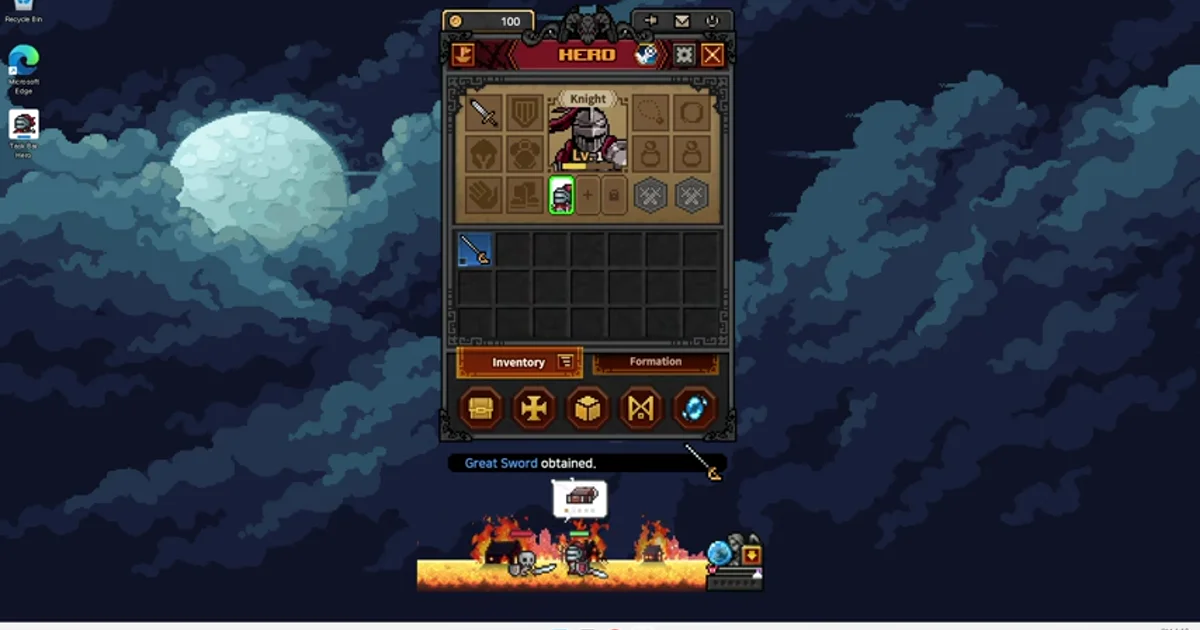
Hero and gear basics in the Task Bar Hero Beginner Guide start here: each hero wears rings, bracelets, earrings, amulets, shields, weapons, helmets, armor, boots, and gloves — all dropping constantly from chests. Check the Status tab for full stats and the Skill tab for your point allocation.
Gear uses rarity colors: Common (grey), Uncommon (green), Rare (blue), Epic (orange), Legendary (red), and higher tiers including Immortal and Cosmic. Read item level and stats, not just color — a high-level Rare can beat a low-level Legendary.
Spend early skill points on basic passives before chasing unknown signature actives. On Knight, prioritize HP, HP regeneration, and block chance; named actives like Shield Charge and Aegis Field come online as you level.
- Equip every upgrade that is strictly better; stash extras sorted by rarity row.
- Free skill respec — adjust once you see which actives your hero actually uses.
- Sorcerer gear is spell-focused; Knight wants armor and block — match drops to the hero wearing them.
Formation & pets in the Task Bar Hero Beginner Guide
Party setup is the highest-impact section of any Task Bar Hero Beginner Guide. The Formation tab lists heroes in your active party. Use the arrow buttons to reorder front-to-back and swap substitutes without cooldown — many new players miss this screen entirely.
You start with one Formation slot. Unlocking the 2nd and 3rd slots via the Rune Tree (Rune of Command) is one of the biggest power spikes in the game. Add the free Priest as soon as slot two opens.
Pets are unlocked by farming specific monsters — for example, enough Bat kills grant the Bat pet. Find a stage that spawns your target mob, stay on it, and grind the kill count. Pets keep their passives even when not deployed.
- Knight + Priest is the usual first duo once two slots exist; add Sorcerer or Ranger in slot three.
- Check our Monsters page for which stage spawns each pet unlock target.
- Supporter DLC includes Dragon — strong gold and EXP boosts, but not required for Act 1.
Stash, chests & inventory — Beginner Guide sorting
Inventory management separates smooth Task Bar Hero Beginner Guide runs from constant overflow. The stash stores chests you are not opening yet. Inventory holds gear you are keeping, sorted by rarity rows: Common on one row, Uncommon on the next, Rare, then Legendary, plus a materials row for crafting reagents from chests.
Open chests when you have inventory space. A practical habit from veteran players: keep greys ready for Alchemy, greens and blues for Synthesis or equips, and reds for your main carry sets.
Extra stash rows come from Rune of Storage in the Rune Tree, or from the optional paid three-row stash pack in the shop. More rows mean fewer forced Alchemy sessions during long farms.
Task Bar Hero Beginner Guide: Hero-dric Cube (Level 4)
The Hero-dric Cube unlocks at hero Level 4 — the next major gold loop covered in this Task Bar Hero Beginner Guide. Not every tab appears immediately; more options show up as you progress.
Alchemy — feed Common (grey) junk you will never equip. This is your main early gold source besides mob drops. Alchemy greys constantly.
Synthesis — combine multiple Uncommon (green), Rare (blue), or Epic (orange) duplicates into one item of the next tier. Only fuse gear that is worse than what you wear; a lucky blue synth can jump a Sorcerer slot by thousands of effective stats.
Processing — craft specific weapons from material ingots that also drop in chests (iron bars, etc.). Use when you are targeting a slot, not on day one.
Decoration — socket colored gems into gear holes on helmets, boots, gloves, and other pieces.
Engraving — similar socketing with engraving materials that add fire, lightning, and other stat lines.
Elimination — strips sockets from gear. Gems and engraving materials are not refunded, so most players rarely use this early.
Offering — trades special offering coins for gold; unlocks later in progression.
- Cube strategy: Alchemy all Common gear → Synthesis excess Uncommon/Rare/Epic → fund Runes with the gold.
- Alt+Click to lock gear before bulk Alchemy so you never melt a keeper.
- Do not starve Rune Tree purchases for early synthesis — gold for Formation slots wins first.
Rune Tree gold priority in the Task Bar Hero Beginner Guide
The Rune Tree unlocks at hero Level 3 — earlier than the Cube, and the main long-term gold sink in this beginner guide. Battles and Alchemy feed the gold counter at the top of the screen.
Your first real goal is party size — Rune of Command unlocks Formation slots 2 and 3. Going from one hero to two roughly doubles output; the third slot is where comps like Knight + Priest + Ranger come online.
While saving for the 150,000g third slot, pick up cheap economy nodes (boss Rune of Wealth, Rune of Repose for offline play) instead of hoarding every coin untouched.
For the full step-by-step priority, branch comparisons, and FAQ, see our dedicated Rune Tree Guide. The Runes database page has the complete 197-node map and table.
Steam Market, shop & free Priest — Beginner Guide extras
The final chapters of this Task Bar Hero Beginner Guide cover optional economy and free DLC. The Trading Ship flag icon opens Steam Community Market listing for Task Bar Hero items — same flow as other Steam economy games. Select inventory, pick the TBH item, set a price, and list. Many players chase Immortal-grade drops for this reason.
Optional paid picks if you support the devs: Supporter Pack (Dragon pet with strong gold and EXP passives) and the three extra stash rows bundle. Hunter and Slayer DLC classes are powerful but not mandatory — free Knight, Ranger, Sorcerer, and DLC Priest cover Acts 1–2.
Priest (the healer) is free DLC, not a paid class. Download the free Priest pack from the Steam store page — she may show locked in-game until the DLC is installed. Grab her before Act bosses; Sanctuary healing trivializes early progression.
Task Bar Hero Beginner Guide: mistakes to avoid
- Leaving Auto-Retry on while repeatedly dying on a push stage instead of farming the previous clear — the most common Task Bar Hero Beginner Guide correction.
- Judging gear by rarity color alone — item level and stat totals matter more early.
- Skipping the free Priest Steam DLC because the icon looks locked.
- Ignoring Formation — running one hero long after you could unlock slot two.
- Synthesizing or Processing gear before Alchemy and Rune Tree gold are stable.
- Using Cube Elimination on socketed gear without knowing gems are destroyed permanently.
- Buying Hunter or Slayer before funding Formation slots and gold runes.
- Letting inventory overflow because stash rows and Rune of Storage were delayed.
More tier lists & guides
Community-reported beginner tips based on early-game stream play — not official Nugem Studio data. Costs, drop rates, and Cube tabs unlock over time; verify in your client after patches.
Sponsored